
Euroroute Logistics
Specialist Logistics Services for Regulated Industries
Ireland exports more pharmaceuticals per capita than any other country in Europe. Pfizer, AbbVie, Johnson and Johnson, Medtronic, and dozens of other manufacturers maintain significant production and distribution operations here. Behind each of those operations is a logistics chain where temperature control, documentation accuracy, and regulatory compliance are baseline features.
But cold chain requirements extend beyond large pharma. Premium food producers, medical device companies, biotech firms, and even consumer electronics businesses moving heat-sensitive components all face similar questions when evaluating a third-party logistics partner. Can this provider maintain the right storage conditions? Do they have the documentation systems we need to satisfy audits? And do they understand the regulatory environment we operate in?
This piece outlines what Irish companies in these sectors should look for, and what questions to ask before committing to a 3PL arrangement.
The Regulatory Framework: EU GDP Guidelines
For pharmaceutical products, the relevant framework is the EU Good Distribution Practice guidelines, enforced in Ireland by the Health Products Regulatory Authority. GDP sets out requirements for temperature-controlled storage and transport, handling procedures, documentation, staff training, and quality management systems. Wholesalers and distributors of medicinal products must hold a Wholesale Distribution Authorisation issued by the HPRA.
If your company does not hold a WDA itself, you need to work with a logistics partner that does — or ensure that the distribution activity falls outside the scope of GDP requirements for your specific product category. A 3PL experienced in pharma logistics will be clear about whether their authorisations cover your product type, and will not take on work they are not licensed and equipped to perform.
For food businesses, the equivalent framework is HACCP (Hazard Analysis and Critical Control Points), which Irish food companies are required to implement under EU food safety regulations. Temperature monitoring, traceability, and documented handling procedures all flow from this.
What Controlled-Environment Warehousing Actually Requires
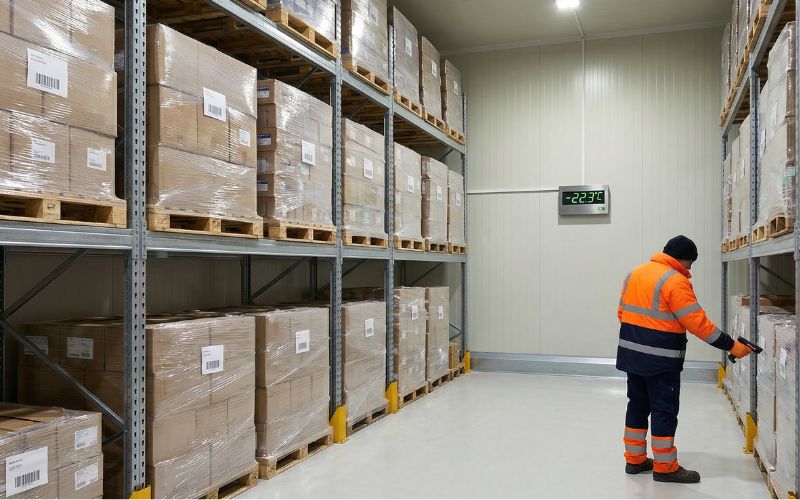
Temperature-controlled warehousing is not simply a matter of having a cold room. A 3PL operating in this space should be able to demonstrate continuous temperature monitoring with calibrated sensors, documented alarm procedures when excursions occur, validated storage zones with defined temperature ranges, and a clear process for investigating and recording any temperature deviations.
They should also have procedures for receiving goods whose temperature history is unknown or potentially compromised, and for handling returns of temperature-sensitive products where the cold chain integrity may be in question. Returns management in cold chain logistics is more complex than in standard fulfilment, and it is worth exploring in detail before signing a contract.
For products with multiple temperature requirements — for example, a medical device company moving both ambient and refrigerated products through the same 3PL — segregation of storage zones and clear labelling procedures matter. Cross-contamination risk, even in temperature terms, is a serious concern for some product categories.
Documentation and Traceability
In regulated industries, documentation is not an administrative burden. It is the evidence that the supply chain worked as intended. For a 3PL partner, this means maintaining complete records of goods received, stored, picked, and dispatched, with lot numbers, expiry dates, and batch traceability where required.
It also means being able to respond quickly to a product recall or market withdrawal. If you need to identify all customers who received a specific batch of product in the last three months and provide evidence of how and when it was stored and shipped, your 3PL needs to have a WMS that can generate that information reliably and quickly.
Ask prospective 3PL partners to walk you through their recall procedure. How long does it take to trace a batch? What format is the output in? Who owns the process? The answers will tell you whether traceability is genuinely embedded in their operations or treated as a secondary function.
Questions Worth Asking Before You Commit
Whether you are selecting a new logistics partner or reviewing an existing arrangement, these questions help establish whether a 3PL is equipped for controlled-environment work. Does the facility hold the relevant authorisations for your product category? What temperature ranges are available, and how are excursions handled? Can they provide temperature data logs for individual consignments? What is their procedure for investigating a cold chain breach? How do they handle temperature-sensitive returns? Who is responsible for quality oversight within the 3PL, and how often are GDP or HACCP processes audited?
Companies that need cold chain logistics often assume this narrows their options considerably. In practice, a well-structured 3PL with the right infrastructure and authorisations can handle this category of work without it requiring a bespoke or unusually complex arrangement. The key is knowing what to look for and asking the right questions early in the evaluation process.