
The cost environment for Irish logistics and product businesses has not returned to where it was. Inflation has eased from its 2022 peak, but the pressures on operating costs have not disappeared – they have settled into different parts of the business. Energy bills remain elevated. Freight rates, which surged and then partially corrected, have proven sensitive to geopolitical disruption in ways that complicate forward planning. For operations and supply chain managers in Ireland, the practical question is not whether these pressures will resolve. It is how to structure operations to absorb them without passing the full impact to customers or to margins.
Understanding where each pressure originates and how it affects decisions that Irish operators make day to day is a good starting point for managing it.
Inflation Has Eased, But Operating Costs Have Not Followed
Consumer price inflation in Ireland and across the EU has moderated significantly since 2022. What has not moderated at the same rate is the cost of the inputs that logistics operations depend on. Labour costs in warehouse and transport have risen and stayed there, the Irish labour market remains constrained and wage increases granted during the high-inflation period have become embedded. Commercial warehouse space, particularly in the Greater Dublin area, has continued to track upward independently of headline CPI. The cost base has structurally reset. Planning that assumes a return to 2019 cost levels is unlikely to produce useful numbers.
Energy Costs and Their Effect on Warehousing and Transport
Energy costs affect logistics operations in two ways.
Directly: warehouse lighting, heating, handling equipment, and charging infrastructure all carry electricity costs that remain well above pre-crisis levels.
Indirectly: the transport carriers Irish businesses depend on have faced the same increases, and those costs have been passed through in rate cards and fuel surcharges.
For operators managing their own warehouse or fleet, the exposure is visible. For those using third-party providers, it is more diffuse spread across fulfilment fees and storage rates which makes it harder to track but no less real. Energy-related cost increases are now a structural feature of Irish logistics spend.
Freight Rate Volatility and the Challenge of Planning
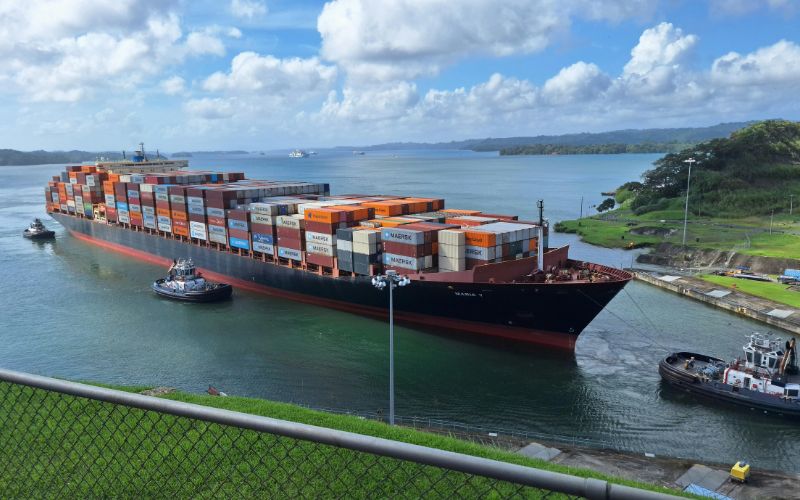
Container freight rates have been among the most volatile logistics inputs since 2020. They surged during the pandemic, corrected sharply in 2023, and have since risen again driven by broader geopolitical instability affecting key trade corridors. For Irish businesses importing products from Asia, this creates a genuine planning problem: the cost of a container shipment can move materially between the point a purchase order is placed and the point goods arrive. Airfreight, used by some operators to bridge disruption, carries its own cost volatility. Supply chains built on historical freight averages are likely to produce cost surprises.
What Irish Operators Can Do
The businesses navigating this environment most effectively tend to share a few characteristics:
– shorter, more visible supply chains where possible;
– variable rather than fixed cost structures;
– logistics partners who provide transparency on cost components, so surcharge increases show up clearly rather than being absorbed into opaque bundled rates.
For Irish operators evaluating their logistics model, the useful question is whether the current structure provides the flexibility to respond when costs shift. These pressures are unlikely to reverse fully. The productive response is not to wait for normalisation but to make the structural decisions that reduce exposure and improve the ability to adapt when conditions change again.
Euroroute provides third-party logistics and fulfilment services to Irish businesses, including warehousing, pick and pack, and B2B distribution. To discuss your specific requirements, contact Euroroute for a practical, no-obligation conversation.